To change the language of this website, you can use the ‘Translate’ function in Google Chrome – Click HERE to find out more.
Welcome to the Careers and Alumni section of our website
Here at Wingfield Academy we are wholeheartedly committed, through our careers programme of activities delivered to Year 7 to 11, to prepare all our learners to make informed decisions about their future/next steps ensuring they maximise their potential and successfully transition into higher education or an aspirational alternative.
Destinations Data
Wingfield Academy uses destinations data — information about where our students progress to and what they choose to do after leaving school — to evaluate the impact of our careers guidance and continually improve the support we offer. This data is published by the Department for Education. Because collecting and verifying destinations information is a complex process, there is always a time delay between students leaving school and the data being released.
Meet the Careers Team

Rosie Bell – Careers Lead – RoB@nclt.ac.uk

Mrs Cerise Walters BA (Hons), PGDip, PGCert, QCG, RCDP – Trust Careers Adviser and Consultant (Secondary Schools) – c.walters@nclt.ac.uk


Jordan Law – Careers Advisor – JLA@nclt.ac.uk
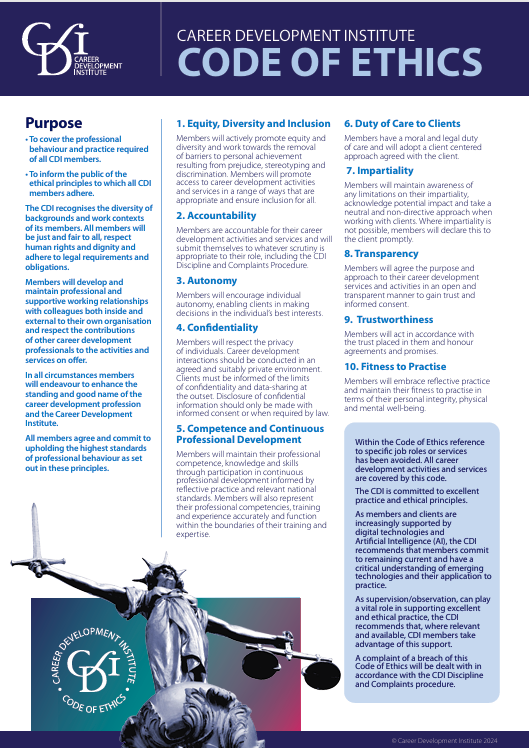
As a member of the Careers Development Institute, we adhere to their high standards of professional behaviours and Code of Ethics. Click the image to view large version.
Careers Programme and Curriculum Learning Journey
Careers Policies
The above policies can also be found at nclt.ac.uk/policies-wingfield-academy
Careers Vision
Wingfield Academy is wholeheartedly committed to supporting our learners to develop into responsible, respectful, model citizens, making a positive contribution to society. Social mobility matters both in terms of people and in delivering economic growth. The world economy is changing, and it is through education, skills and training from childhood into adulthood that we will make sure no one is left behind.
We at Wingfield Academy want to ensure that our young people are provided with the opportunities to enhance their life skills which will not only increase educational success but will support them to go as far as their talents and aspirations will take them.
At Wingfield Academy we are committed to providing our students with a programme of careers education, information, advice and guidance (CEIAG) for all students in Years 7-11 that will inspire and motivate them from an early age. We will support our students in making well informed choices about subjects and careers for their future.
This is primarily achieved through our careers programme, which is delivered to all pupils from Year 7 to 11. This programme encourages young people to develop the knowledge, skills, resilience, confidence and independence they need to make reasoned and informed decisions about their next steps. This helps them maximise their potential, supporting them in successfully transitioning into higher education or an aspirational alternative.
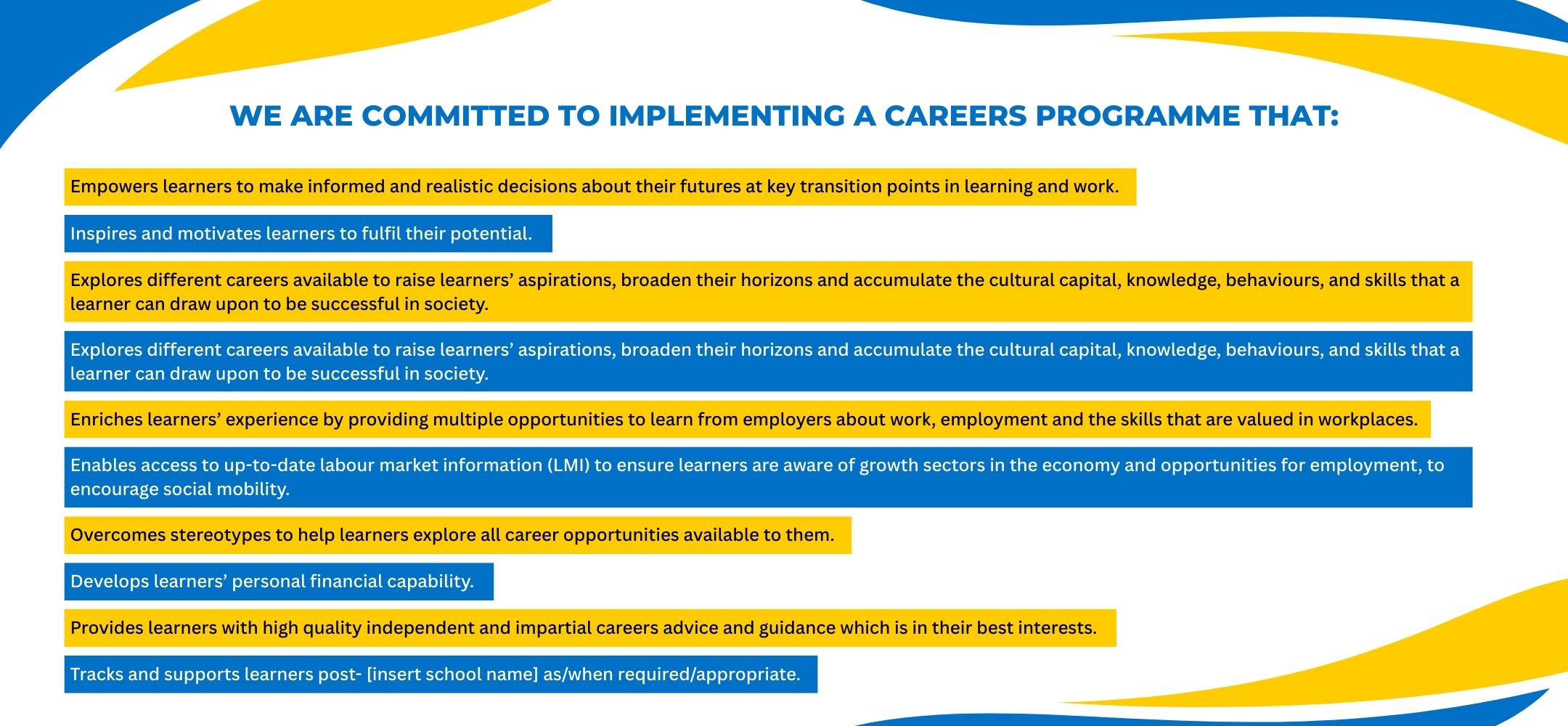
Gatsby Benchmarks
The eight Gatsby Benchmarks define world-class careers guidance for young people in England, based on international evidence. They have been central to government statutory guidance for secondary schools since 2018. The refreshed 2025 Gatsby Benchmarks, retain the original 8 benchmarks whilst introducing 5 Core themes which are:
- Careers at the heart of education +leadership – embedded in schools’ vision+ strategic plan
- Inclusion and impact – meeting the individual needs of every learner
- Meaningful and varied encounters and experiences – focus on quality and impact
- Information and data – careers data actively used to inform decision making
- Engagement of parents/carers – recognising their significant influence on career decisions
Below provides a brief summary of each benchmark as defined by the Careers and Enterprise Company.
The Benchmarks
Benchmark 1 – A stable careers programme
Every school and college should have an embedded programme of career education and guidance that is known and understood by students, parents, teachers, governors and employers.
Every school should have a stable, structured careers programme that has the explicit backing of the senior management team, and has an identified and appropriately trained person responsible for it.The careers programme should be published on the school’s website in a way that enables students, parents, teachers and employers to access and understand it. The programme should be regularly evaluated with feedback from students, parents, teachers and employers as part of the evaluation process.
Benchmark 2 – Learning from career and labour market information
Every student, and their parents, should have access to good quality information about future study options and labour market opportunities. They will need the support of an informed adviser to make best use of available information.
By the age of 14, all students should have accessed and used information about career paths and the labour market to inform their own decisions on study options.Parents should be encouraged to access and use information about labour markets and future study options to support their children.
Benchmark 3 – Addressing the needs of each student
Advice and support should be tailored to the needs of each student. Keeping good records of students and their destinations after school will help.
A school’s careers programme should actively seek to challenge stereotypical thinking and raise aspirations. Schools should keep systematic records of the individual advice given to each student and subsequent agreed decisions. All Students should have access to these records to support their careers development.
Schools should collect and maintain accurate data for each student on their education, training or employment destinations for at least three years after they leave school.
Benchmark 4 – Linking curriculum learning to careers
Careers and enterprise education should be part of and included in student’s standard lessons, linking curriculum to real- world career paths.
Science, technology, engineering and mathematics (STEM) subject teachers highlight the relevance of STEM subjects for a wide range of future career paths.
By the age of 14, every student has had the opportunity to learn how the different STEM subjects help people to gain entry to a wide range of careers.
All subject teachers emphasise the importance of succeeding in English and Maths.
Subject Based Career Advice
| Subject | Linked Careers | Work Skills |
| Art | Art Careers | Art Work Skills |
| Biology | Biology Careers | Biology Work Skills |
| Business Studies | Business Studies Careers | Business Studies Work Skills |
| Chemistry | Chemistry Careers | Chemistry Work Skills |
| Childcare | Childcare Careers | Childcare Work Skills |
| Computer Science | Computer Science Careers | Computer Science Work Skills |
| Dance | Dance Careers | Dance Work Skills |
| Design & Technology | Design & Technology Careers | Design & Technology Work Skills |
| Engineering | Engineering Careers | Engineering Work Skills |
| English | English Careers | English Work Skills |
| Food | Food Careers | Food Work Skills |
| Geography | Geography Careers | Geography Work Skills |
| Health and Social Care | Health and Social Care Careers | Health and Social Care Work Skills |
| History | History Careers | History Work Skills |
| Maths | Maths Careers | Maths Work Skills |
| MFL | MFL Careers | MFL Work Skills |
| Music | Music Careers | Music Work Skills |
| PE | PE Careers | PE Work Skills |
| Physics | Physics Careers | Physics Work Skills |
| RE | RE Careers | RE Work Skills |
Benchmark 5 – Encounters with employers and employees
All students should have encounters with employers and employees that result in a better understanding of the workplace and the potential career paths open to them.
Students should participate in at least one meaningful encounter with an employer every year from the age of 11. Work with your regional local enterprise advisor to make sure you are aligning to the strategic plan of the region. Current Position: 30th June 2020 Previous Position: 23rd January 2020
Our academy has met 100%, previously 100% of the 1 assessment area compared to 52% average nation.
Virtual Work Experiences
- Oil and Gas Industry
- Ecologist
- Civil Engineer
- Estates and Contracts Manager
- Acoustics Consultant
- Technical Manager & Design Coordinator
- Ground Worker / Machine Operative
- Arborist
- Architect (Partners)
- Design Assistant (Architects)
- Careers Adviser / Employment and Skills Manager
- Senior Communications Manager
- My Path- Job of the Week Careers in Education Videos
Benchmark 6 – Experiences of workplaces
It’s important for students to experience the workplace environment to understand the context in which they could one day be working.
By the age of 16, every student should have had at least one experience of a workplace, additional to any part-time jobs they may have.
By the age of 18, every student should have had one further such experience, additional to any part-time jobs they may have.
Benchmark 7 – Encounters with further and higher education
Careers provision should cover further and higher education as well as potential professions. Students should have encounters with these organisations whilst at school.
By the age of 16, every student should have had at least one experience of a workplace, additional to any part-time jobs they may have.
By the age of 18, every student should have had one further such experience, additional to any part-time jobs they may have.
Benchmark 8 – Personal guidance
Every student should have opportunities for guidance interviews with a career adviser, who could be internal or external, provided they are trained at an appropriate level.
Every student should have at least one guidance interview with a CEIAG adviser by the age of 16, and the opportunity for a further interview by the age of 18.
Alumni and Community Volunteer Network
We warmly welcome connecting with our alumni and other members of our community who wish to support our school and students in any way. To register to be part of our Alumni and Community Volunteer network, please contact the Careers lead whose details can be found at the top of this page.
Careers Information for Employers
Thank you for considering supporting Wingfield Academy with their careers activities this year.
We aim to excite and inspire young learners about their next steps. As the Government does not provide schools and colleges with dedicated funding for careers provision, we cannot achieve this without your support and involvement!
Please indicate your interest in supporting our upcoming careers events. This will add you to our careers database so that the careers team at Wingfield Academy, can get in touch nearer the time of each event to formally invite you and provide further information.
We would also be exceedingly grateful if you could send this information to any of your friends, family, and colleagues who may also be interested in getting involved.
If you have any questions, please feel free to email the Careers Leader (details at the top of this page) Our data protection policy can be found on our Policies page.
Evaluating the Impact of the Careers Programme
The success of our Careers Team and Careers Programme can be measured in a number of ways. Through the year, and at the first LGB of each new year, we provide information to our Governing Body on:
- Number of students who are not in education, employment or training after Y11 or Y13 (NEETs)
- The range of Careers Opportunities that students have had access to including:
- `Trips & visits to careers fairs, employers, HE & FE providers
- Work experience
- Visitors into school from employers and other providers
- Careers information through Life, Guidance and Form Time
- Meetings with careers team/careers advisor
- How we compare to the Gatsby Benchmarks
- This information is reviewed each year with the LGB.
We also use the Compass Plus toolkit to assess our progress with our careers work.
Careers, HE and Apprenticeship Links
Unifrog

The universal destinations platform. All students from Y7 to Y11 have a Unifrog account where they can research careers, work experience, subject areas, skills, apprenticeships, higher education and much more! Get your son/daughter to log in with their school email address and explore this together. Unifrog – The universal destinations platform.
Student Stream
UK University Search are proud to announce the launch of our new website www.studentstream.co.uk. The website brings together a wealth of video resources by us and universities across the UK in one place.
National Careers

https://nationalcareers.service.gov.uk/ website offering all types of careers related information including local labour market information, CV writing, skills and qualifications required for all types of careers.
icould

https://icould.com offering careers videos and job information.
National Apprenticeship Services

https://www.gov.uk/topic/further-education-skills/apprenticeships National Apprenticeship Service.
Pathways Explore

Explore your future with confidence using our interactive careers library, Pathways Explore. Whether you’re deciding on your next steps or just curious about what’s out there, this easy-to-use tool lets you search over 800 careers, take a short personality quiz, and discover job roles that match your interests. Linked directly to our courses, it’s a great way to see how your studies can lead to exciting opportunities.
You can access the Pathways Explore service on any of our Trust’s colleges or school sixth form websites.
Parents

Skills for Careers – View support and information for helping your child with their career and education decisions.
Apprenticeships – Links to support parents with helping their child applying for Apprenticeship opportunities.
Other Links
Careers Pilot – A site to help you support your young person in making the right decision about work and study.
Youth Employment – A site to help parents/carers signpost their child to information on education, training and work.
Results Day Support – Tips of parents and carers on exam results day.
Talking Futures – A site containing a wealth of information on your child’s career options.
Careerometer – Labour Market Information
Labour Market Information (LMI) is data about jobs, careers, salaries, skills, training opportunities, and employment trends. It helps you understand which jobs are available, what qualifications are needed, and which careers are growing or declining. Using LMI can help you make informed decisions about your education, training, and career choices, increasing your chances of finding rewarding employment and planning a successful future. Use the tools and links here to help you plan for your future:
South Yorkshire Mayoral Combined Authority – South Yorkshire MCA